Edge AI’s real promise isn’t speed. It’s making the decision where the problem is
AI is moving out of the data centre and onto trucks, utes, drones and sensors. Here’s what that looks like in the real world — including four problems we’re working on, from smoke and road signs to paddocks and pits.
Most of the excitement in AI still points at the data centre — bigger models, bigger clusters, bigger bills. But some of the most useful AI of the last two years has been moving in the opposite direction: out of the cloud and onto the device, to the exact spot where the problem actually happens.
This is edge AI, and the reason it matters is unglamorous. Out in the real world, you often can’t afford the round trip to a server. Sometimes there’s no connection at all. Sometimes the decision has to happen in milliseconds, or the data is too sensitive or too voluminous to ship anywhere. So you put the intelligence on the device, and it decides on the spot.
That sounds like a plumbing change. It’s actually a change in what AI is for. The cloud is good at answering questions. The edge is good at making decisions where there’s no time to ask one.
You can already see it working across industries. On factory lines, cameras run vision models locally and catch defects across thousands of parts an hour without sending a single image to a server. In agriculture, drones spot crop disease mid-flight on compressed models, instead of flagging it days later back at the office. On remote equipment, vibration sensors predict a bearing failure on-device and run for months on a battery in places with no signal. In healthcare, portable ultrasound analyses images at the point of care. In cars, in-cabin sensors detect a child left in a back seat in real time, with no cloud in the loop. Different industries, same move: the intelligence goes to where the data is born.
At Edgegenix, this is the principle we build on — and four of the problems we’re working on show why the edge is the only place some of these can be solved at all.
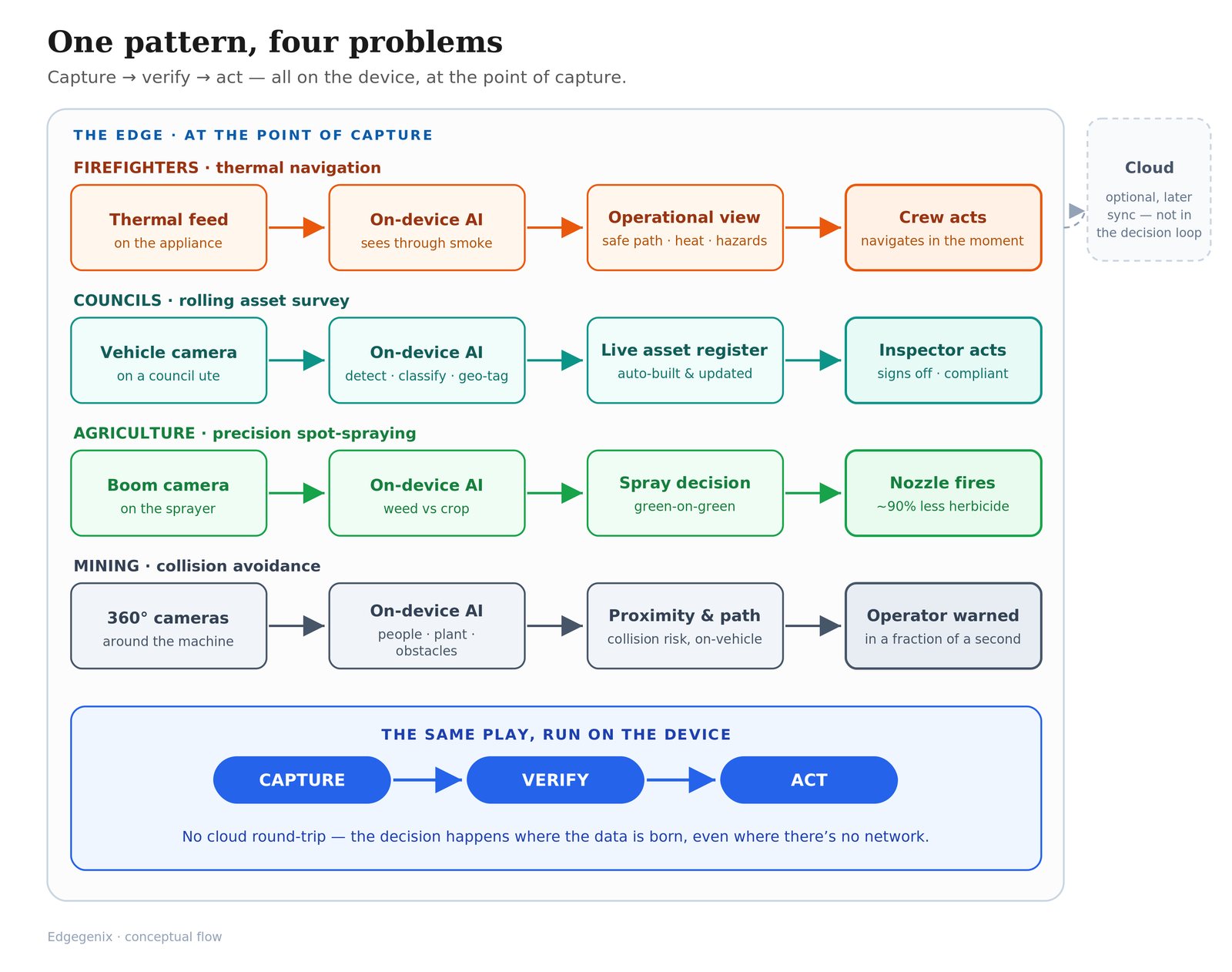
Thermal imaging has been a firefighter’s quiet superpower for years: infrared sees heat through smoke that blinds the naked eye. But a raw thermal feed is not the same as knowing what to do with it while a crew is moving and conditions are changing. That’s the gap we work on. We take a thermal feed from a unit mounted on the appliance and turn it, on the device, into operational intelligence — clarifying what’s ahead, where the heat is, where the safe path runs — fast enough to be useful in the moment, not after it. The research here is encouraging: deep-learning models on thermal imagery have shown over 95% precision detecting people in heavy smoke at full video frame rates. The crew still drives. The crew still decides. We extend their senses and shorten the distance between seeing and knowing — and on a fire ground, with no reliable network, that has to happen at the edge.
The second problem looks completely different and is built on exactly the same idea. Every local council is responsible for a sprawling, scattered inventory of road signs and roadside assets — and in most places they’re legally required to maintain an accurate register of it. The reality is that these registers are perpetually out of date, because the only way they’ve ever been kept current is people manually auditing roads, one stretch at a time. So we put edge AI on ordinary council vehicles. As they drive their normal routes, the system detects, classifies and geo-tags signs and assets in real time, building and updating the database automatically. No special survey crews, no images shipped off for processing later — a 200 km network can be covered in a handful of ordinary driving days. An unglamorous problem, quietly solved, with real safety and compliance consequences underneath it.
On broadacre farms, the cost and chemical load of herbicide comes from a blunt instrument: spraying a whole paddock to kill the weeds in part of it. So we put edge AI on the sprayer. A camera on the boom feeds an on-device model that tells weed from crop in real time and fires only the nozzle above the weed — “green-on-green” — while the rig moves at working pace. In real-world trials, on-device spot-spraying matched blanket spraying for weed control while cutting herbicide use by up to 65%. There’s no time to consult a server between seeing a weed and passing it, and a paddock rarely has the signal to try anyway. The call gets made on the boom, at the edge.
A loaded haul truck has blind spots big enough to hide a light vehicle or a person on foot, and the cost of missing one is severe. So we put edge AI around the machine. Cameras feed an on-device model that detects people, plant and obstacles in real time and warns the operator within the fraction of a second they have to react — calculating proximity and likely collision paths on the vehicle itself, processing the feed faster than 20 frames a second. Open-cut pits and underground drives are exactly where the network isn’t, and a collision warning that has to round-trip to the cloud is no warning at all. It has to happen at the edge.
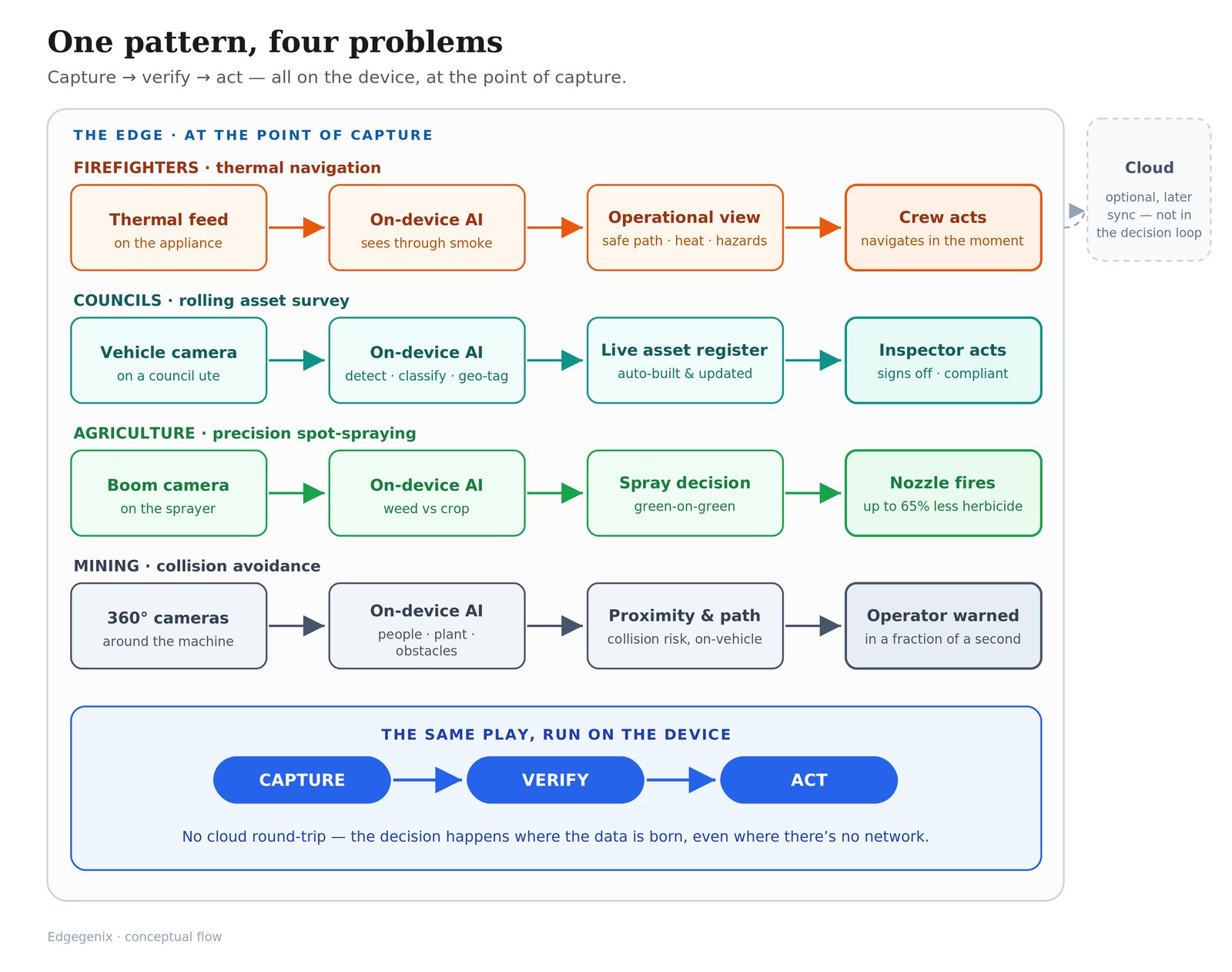
Line up all four — a fire appliance pushing into smoke, a council ute on a quiet road, a sprayer crossing a paddock, a haul truck in a pit — and the common thread is obvious. In every one, a raw sensor feed becomes a decision at the point of capture. Verify what you’re seeing where you see it; act on it without waiting for a network that may not be there. That’s the whole game.
It’s also why “edge” isn’t just a technical preference for us. Connectivity is the tell. If a job has to work where the network doesn’t — a fire ground, a remote road, an open-cut mine, a paddock — then it’s an edge problem by definition, and a cloud-first design will fail it exactly when it’s needed most.
None of this replaces the people doing the work. The firefighter drives and commands. The council inspector signs off. What edge AI removes is the latency between seeing and knowing — the gap where, historically, the cost has always hidden.
The data centre will keep getting the headlines. But more and more of the AI that actually changes an outcome is going to live on a truck, a ute, a drone, a sensor on a wall — making the call where the problem is.
So the question worth asking about any AI system now isn’t only how clever it is. It’s where it runs — and whether that’s close enough to the problem to matter.